 Go back to History of 272nd Infantry Regiment
 Go back to History of 272nd Infantry Regiment
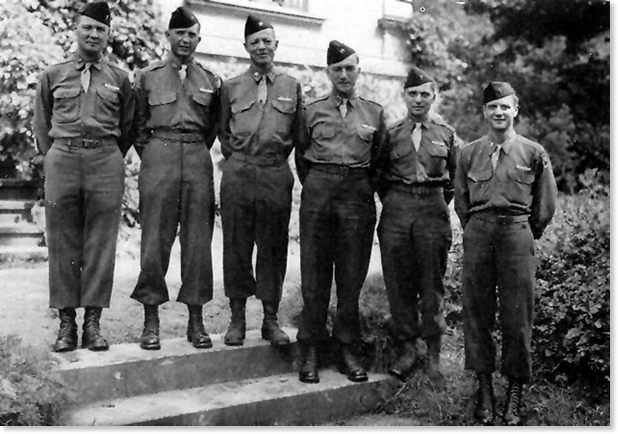 |
| Photo left to right: 1st Lt. Robert W. Griffith, S2; Maj William M. Zimmerman, Bn Exec Officer; Lt. Col. Allen D. Raymond, Bn Commander; Capt. Norman Buckholtz, S3; 1st Lt. William A. Frank. S2; 1st Lt. Donald C. Swan, S4. |
The easiest things to remember are always the hardest battles we fought, the coldest and wettest nights we stood guard, the most miserable of the miles that we tramped. But along the route that started at Le Havre and ended at Torgau were other pertinent incidents that made the 1st Battalion’s history unique in its way – things that stayed in the memories of the men who experienced them, longer and more vividly than any other.
Charlie Company likes to remember its first taste of the conqueror’s life when they reached Brohl on the Rhine. The 1st Platoon and Machine Gun (MG) Sections set up their positions on a small island in the river; from there they had orders to shoot any suspicious-looking objects that floated downstream. On the west bank was the Mortar Section pumping illuminating shells every time anything suspicious was sensed. The rest of the Company was spread through the town, either in the Bahn Hotel or an elegant town house that was on the extreme edge.
“It was almost a dream life for a while,” one of the Headquarters (HQ) men recalls, “and it continued until Corps placed a conscientious guard on the cave where the town drew its cognac supply.” But a hurried reconnaissance was made which uncovered a well-stocked winery on the far side of the river. Until the last day, C Company occupied this town of Brohl, and a ferry system was in operation between the two banks. The 1st Platoon used its tactical position to good advantage; under cover of darkness, the men would row to the far shore to pick up a choice cargo of champagne and Rhine wine. Much of their supply was funneled to the rest of the Company in exchange for Jerry cigars, cigarettes, and jam. The Engineers’ boat that brought the 1st Platoon’s chow became a semi-precious treasure ship, always carrying a prize cargo. When the outfit left Broach, most of the men carried a liquid souvenir of the town in their canteens, and, contrary to Army Regulations, it harmed nothing – not even the canteens.
About this time, the men of the Battalion were reaching the phase line that ended the preparatory stage for combat. If one talked with any of the soldiers ready to cross the Rhine River, he could get a quantity of stories about their training in the States, the few months in England, or, most certainly, the experiences on trucks in France or in the woods of Belgium.
Each man remembered the night that the outfit landed in France. While the duffle bags were being dragged through the mud, not a man in the Battalion could see a cheery welcome to the country that pledged sunshine and soft air in the travel folders.
Men of Company D, when they moved to their billet area at Fenquires, found that part of the Company had been loaded in the wrong trucks. A few arrived at the front long before they were scheduled to get there, while others reached the outskirts of Paris. For two days, the Company was split in all directions. Finally, all converged once more in the new billets, where the men were already learning how the worst possible housing in the European Theater of Operations (ETO) can become comfortable when wit and ingenuity are used.
Nevertheless, a night in the woods isn’t housing, and nothing short of a steam radiator could have made the bivouac area among the Belgium firs a comfortable one. These were the most miserable of the bad nights spent. Foxholes were to be dug, but the spadework never passed the slit trench depth. The ground was frozen, and even all the ponchos and blankets that could be mustered were little help. Teeth still chattered between fits of sleep. Moreover, the puddle in the bottom of the hole got deeper and deeper. Nevertheless, it felt less damaging than the wind that blew overhead.
One night, the darkness was so intense that men wandered away towards both the enemy and the rear. Pfc. Arnold of B Company walked 10 yards from his tent and spent the next 15 minutes trying to get back. Guard reliefs that night were unreliable, too. Even when the relief was to be called by the guard himself, there was no certainty that his tent could be located. Just before dark, S Sgt. Slaich carefully marked the path he was to walk to awaken the next guard, but two hours later, that path was invisible. After an hour’s fruitless search, with nothing to show but scratched hands and face, he returned to his post and the easiest choice – to take the next guard shift.
“But those nights weren’t the worst,” Pfc. Nyland constantly repeats. “I remember a short jaunt of 13 miles we were to take through the woods one afternoon. Trucks were to pick us up at 2 o’clock. We were waiting beside the road long before that time rolled around. “About 9 o’clock that night, the buggies finally arrived. It was raining harder than I’ve ever seen over here, and the wind blew it cold into our faces.
“After the duffle bags were thrown into the truck, we piled on – 25 of us with our packs on our backs. I sat on top of the cab, where I thought I could find plenty of room. But when the rain came down harder and it grew colder later that night, I regretted that move. To keep warm, I cursed everything connected with the Army, with Europe, and with winter warfare.” Those 13 miles took 12 hours to cover, and the rain never stopped as long as the ride went on.
Here are a few other incidents before the Rhine was reached: The 3rd Platoon of Company B, when it reached Neuhof, searched a long time before the men found a billet they thought suitable. What distinguished it from every other shelter in the area was the cellar, which was deep and valuable now that Jerry was zeroing in his artillery. Only a few minutes after the Platoon settled downstairs, someone selected it for the Battalion Command Post (CP); the troops were told that the basement was requisitioned, but that the first floor was free if they wished it. Fine, except that the first floor was uncomfortable when shells fluttered by. Each time another one was announced, the boys hit the floor hard. Very soon, word was brought from downstairs that there was too much noise overhead; the pounding would have to stop. It did a few minutes later, when shelling became extremely heavy. Every Joe on that first floor went on temporary duty to Battalion Headquarters and stayed there until the shelling had ceased.
On the Siegfried Line, the Battle Patrol moved into its lead position for the Battalion, as it did for the greater part of the actions through Germany. The Patrol’s first mission was a thrust into the Line itself; three pillboxes that lay in the Battalion’s path had to be neutralized. It was a snowy afternoon when Lt. DeLoach and his five men started out. Pfc. Denton Morriss spotted the first pillbox, a huger bunker-type affair that had lain completely concealed until the men were almost upon it. Luckily, that one was empty; nothing more was done except to note its position. The men crawled on under machine-gun fire to the fringe of the woods, 500 yards away.
So it went – four hours of creeping and hitting the snow banks while the machine guns hammered and the remaining boxes were taken over. Lt. DeLoach made two more trips later in the day. Communication wire had to be brought up; later, a platoon of Company A moved up to take over the boxes. The Battalion pushed through the line the following night. As the Battalion went through the Line, the enemy retreated as fast as their feet or their horses and wagons could carry them. Pressure from the North and South, and a threatened scissors movement at their backs, forced them to reach the Rhine at the earliest moment. For the Battalion, this meant more hiking, closely following the enemy until Dahlem was reached. For the next few weeks, while the pocket in front was slashed and consumed, there was very little to be done – roadblocks, and as usual plenty of guard. Showers, movies, and even a Red Cross Clubmobile made the rounds once or twice. In addition, there were houses to stay in. This, above all else, was the best thing that awaited the men after the nights in the woods. The sorrowful owner of D Company’s headquarters billet watched the progress of slit trenches across her garden and one day pleaded, “No farther in that direction, please. My chinaware is buried there.”
The night that the Rhine was crossed, the Battalion was part of an army that was on the move; the impetus didn’t stop until Germany was split in half. The crossing was made at San Sebastian under a pale moon. Under its light, the valley lay clear and bright while the men waited their turns for a boat ride in landing craft piloted by sailors who wore OD’s (olive drabs) for their job.
The Infantry-Tank team that raced up the Lahn River Valley the next day was yet another piece of the pattern that made the dash across Germany swift and decisive. B Company was the first to climb on. The team, each member strange to the other, worked smoothly; the mutual respect for this Infantry-Tank team was born there and still flourished when Leipzig had been conquered.
In one afternoon of tank riding, many towns, including Nassau, fell. The first large groups of the thousands of prisoners the Battalion eventually was to send to the rear went back that day, most of them persuaded to surrender by the rumbling roar of the threatening tanks. French prisoners were heard singing the Marseillaise loud and strong as the tanks with infantry approached the last town.
S. Sgt. Garrison climbed off his tank as darkness began to fall and started to walk back through the town with two Italian PW’s (Prisoners of War). Few German soldiers were left, it was thought. Most of them had been flushed out quickly just after the town fell. Nevertheless, as the Sergeant approached a corner, one German non-com, a rifle in his hand, stepped out from behind a building.
Lined up in the German’s sights, Garrison didn’t know whether to duck or seat. Instead, the Jerry walked over and asked if he was American. “Yes,” answered the Sergeant; promptly the German turned to whistle. From bushes that flanked the street, 10 Jerries stepped out. Through the non-com, everyone in the German squad surrendered to Garrison, who was thoroughly bewildered by this time. That was the first of many incidents, most of them humorous, when Germans in large groups surrendered to only a few Americans. Ninety-nine had surrendered to the Battle Patrol that day.
Sgt. Wood raced into a cellar, M-1 cocked and ready, where he found a Jerry platoon sitting against the walls with their packs already on. The men glanced at Wood and filed out hastily. Another patrol member, Pfc. Denton, was waiting outside with a squad of them who had been rounded up only a short time before. As the men rode through newly won Kassel the afternoon of April 5, most of them didn’t know that they had finally caught up. C Company was riding the lead tanks as the 80th Division was overtaken east of the town. In their happiness when the doughs of that Third Army Division heard they were to be relieved, they turned over half the souvenirs picked up in Kassel.
Landwerhagan, which was a few miles ahead, offered heavy resistance, and C Company deployed for assault. Working with the armor, the Company forced its way into town, past the houses and barns that tracer fire had ignited. Houses were systematically searched out and outposts established.
B Company, which had been in support, moved up the main street to the far end of the town, where it was to choose billets. The doughs were at the town’s edge when suddenly the Jerries counterattacked. The approach of the enemy was over a flat, open space that led up to a few houses within the town’s limit. The Krauts were only 100 yards away when they were seen heading for the main road that led out of town and for the houses themselves in an attempt to outflank the defenders and to provide cover for them.
Three members of B Company’s point squad saw the threat to that road and ran out to positions alongside it. One of them, Pfc. Anderson, fired his BAR (Browning Automatic Rifle) until the Jerries ducked for cover. Alongside him, Pfc.’s Evans and Lopez, who had come up by hurdling fences through heavy fire, assisted with their rifles. The rest of the company had meanwhile set up firing positions in the houses.
The superior American firepower was poured out on the plateau each time a Jerry tried to scrabble out of his hole. Until a tank moved out of town to fire on the Jerries’ flank, the fire was maintained, and men were moved from positions in the houses to a line which the three point men had begun beside the road.
At that time, Major Zimmermann, Battalion Executive Officer, led an attack that brought the Jerries out of their holes. The number of dead, wounded, and captured among the enemy was heavy; futile attempts to destroy the tank with a Panzerfaust or to shoot at B Company’s men through the screen of surrendering prisoners only added to the total.
Next morning, Benterode was attacked and taken. Each man in B Company remembers this place and its action more vividly than any other town.
The Jerries had prepared their positions well. Benterode was at the bottom of a hollow which rose steeply on the right flank, while the hill to the left rose more gradually, its top crowned by a wooded patch. A wide ditch paralleled the road into the town. In this ditch, in foxholes dug into the sidewalls, were Jerries. In addition, the hills on each side held dug-in riflemen, machine guns, and automatic weapons. Enemy artillery was zeroed in on the town and its approaches.
With D Company in mortar and machine-gun support, the 1st Platoon approached the town along the ditch and through the field that lay to the left of the road. The 3rd Platoon attacked enemy positions on the hill to the right, while the 2nd Platoon, which had come up in support, was to dig in, ready to throw back anything from the other hill that threatened the advance.
As the enemy-held positions in front of the houses maintained constant rifle and machine-gun fire, the Company was under shellfire from the moment it approached the town. They approached slowly, cautiously, through the ditch, crawling on their bellies.
Valuable lessons were learned that day, and heroic actions were commonplace. A scout for the 3rd Platoon moved ahead when the men were pinned down on the hill. Even though machine-gun fire was coming from the crest, at the same time, the exact positions were difficult to pick up. The Germans had blended their holes with the surroundings and used their background with intelligence.
Pfc. Mortensen, the Scout, still had no idea where the fire was coming from when he started up the hill. Behind him, his squad leader, S Sgt. Garrison, had divided the squad into Able, Baker, and Charlie teams. Before the action was over, this system was to prove itself.
When only 25 yards away from the fire, Mortensen found its source. Ahead of him, at the hill’s crest, were four machine guns, each one with a superb view of every foot of the hill to the bottom.
With Garrison close behind him providing a cover of fire, Mortensen crawled to within a few yards of the first hole and threw a grenade. That machine-gun nest was instantly neutralized, and a short time later, the second was dealt with in the same manner. The Jerries who remained had seen what happened; Mortensen’s threatened M-1 fire was enough to force their surrender. The hill was free from fire and the Platoon reached the top.
A liaison plane that had circled overhead for some time now dropped lower until it was only a short distance above the men’s heads. Looking up, they could see the pilot waving and pointing. Some could hear him yelling. Suddenly diving more steeply, he threw a grenade from the plane to a spot not far from where the men had just established their positions. They realized what he meant. The grenade landed a short distance from another hole filled with Jerries playing possum for the moment. That position was also quickly taken.
Benterode fell after a few hours, and the Company moved on. It left behind men like T Sgt. Spencer and Pfc. Schulke, who had been killed while in front of their men, directing the advance towards the enemy positions. Their spirit stiffened the men in face of the heavy enemy fire.
Men walked in their sleep that night; they walked until their legs operated only through habit and seemed an abstract part of them. Contact was maintained only by clutching the gas mask strap of the man who marched in front. When the line halted, there were collisions from front to rear.
As dawn appeared in front of the marching troops, the first glare of a burned-out Tiger tank shone up ahead. It was one of the Panzers that had molested the column the previous day. Now, set afire by its crew, the tank still appeared powerful as the men filed by.
C Company, after a bitter fight, took Klein Almerode. The Battle Patrol, which had moved into the woods while the town was being taken, came out with 17 Krauts. They were the remains of a small force that was concentrated in a hollow waiting for all the troops to bypass their position. When the Krauts attempted to play dead as the Battle Patrol approached, they were jumped by the suspicious point man.
A Company went ahead to clean out the intermediate village, beyond which lay Witzenhausen, the Battalion’s largest objective. The town lay on each side of the Werra River and was important because a crossing was needed there. When Witzenhausen was reached, the Regiment would be on line.
The Battle Patrol worked around the town and through a gully along the river, always under sniper fire. Their objective was the all-important bridge, which was to be secured for the crossing. B Company walked toward the bridge through the town after sniper nests had been cleared.
Nevertheless, the Germans blew up the bridge while the Americans approached. A squad led by S. Sgt. Abraham was only 40 yards away when the blast knocked them back against the walls of the building and showered the men with debris.
In a hurried consultation at the bridge approaches, Lt. Col. Raymond, close to the center of action as usual, decided it should be crossed. Led by the Battle Patrol and directed by Capt. Jackson of D Company, the Companies clambered over the pile of rubble, some of the men hitting loose rocks and falling to the river. But they got on their feet, climbed back on the heap of rubble, and started off again.
Supported by elements of D Company and tank fire from across the river, the eastern bank was quickly cleared out. The men waited for tanks to counterattack that afternoon; instead, they received Jerries who rode into town on bicycles, trucks, and motorcycles. All were unaware that the town had fallen. The race for Leipzig and the Elbe had begun.
Again, the Infantry-Tank combination worked. The doughboys learned how to make the most comfortable seat on a tank that had to be ridden 10 hours a day. They learned to keep away from the rear of a tank destroyer, where the heat from the motor would shrivel them in the daytime, but to stay near that heat when the march continued at night. That was the only means of keeping warm. K rations were reluctantly tucked into pockets and under jackets with a hope that the kitchen would catch up for hot chow in the morning. The men rode on trails lined with apple trees in blossom, over dirt roads that rocked them from side to side, and through fields when there were no other routes.
Thousands of freed slave laborers lined the route, clustered at corners in the towns, pausing for a moment and staring at the steel parade. The German civilians were awed by the power that rolled by.
Bivouacked for the night on the road overpassing the Autobahn east of Naumburg, guards stopped several German vehicles passing along the superhighway. The driver of one vehicle didn’t hear the guards, but bullets stopped him. As the cars burst into flames, two men escaped, while the other two, both wounded, were pulled away from the wreckage. One was asked if he had ammunition in the car. While vigorously replying, “Nein, Nein,” the vehicle sounded off like a corn popper. High sheets of flame lighted up the entire area; the car burned for hours while the men sweated it out beside the road.
The sun set each evening directly behind the long column; to the Joe riding a tank, the objective was a river called the Elbe. Scores of towns were passed, some of them providing a bed of 30 minutes’ notice – but the name of each was forgotten when the tanks had passed the last house.
At Kohra, the Ninth Armored veered off; our objective was now Leipzig. While the 2nd Division attacked from the west, men of the 69th Division, in order to launch the attack, drew a partial ring about the city, encircling the southern outskirts and villages to the east of Leipzig.
The Battalion attacked the city on April 18. After our stiff fight around the railroad station, our mission was accomplished early the following morning, when contact was made with the 2nd Division. During the night, B Company, with the Battle Patrol and elements of the Battalion staff, stalked silently the dark, sinister streets of the city and through the park to make this contact.
Upon entering the city, many German civilians were in the streets cheering and waving white flags. Mixed among them were groups of slave laborers. From somewhere a huge French flag was produced. Some tried to push to the center of the street and press flowers and glasses of beer on the soldiers. The mass had to be threatened with rifles before it would withdraw to the building line or inside the houses.
Following the capture of Leipzig, our Battalion withdrew to towns north of the city, to await orders. Meanwhile, reports about the Russians were circulating. One newscast reported them 15 miles away. Another declared that a juncture of the two armies had been made. Next day, both reports were contradicted by a new one.
On the 26th of April, the Battalion did more than make actual contact with the Russians. On the road that stretched from the Mulde to the Elbe Rivers, the 1st Battalion stood guard for the next two weeks and watched the headlines ride by. The Russian honor escort sent to meet Major General Reinhardt and Major General Hubner near Torgau was composed of twice-wounded veterans, plus an interpreter who had to be helped with his translation by S Sgt. Mike Lewis, on guard at that point.
The Battalion remembers the Russian soldier as he appeared with his ever-present machine gun, the vodka bottles, and the long lines of carts that hauled lumber to the bridge being built over the Elbe. The war was over a few days later. The Battalion’s successful combat history was ended in Europe.
Go back to History of 272nd Infantry Regiment
Site support by Leader Technologies® — provider of Leader Phone® audio conferencing and teleconferencing services.